Stupid Is as Stupid Does: Meaning, Origin, and Cultural Impact
 James Bradley
 Few movie quotes have penetrated popular culture quite like "stupid is as stupid does." The phrase rolls off the tongue with deceptive simplicity, yet carries philosophical weight that has kept it relevant for over three decades. What sounds like a straightforward statement about foolishness actually challenges how we evaluate intelligence, character, and human behavior itself.
This seemingly simple line from the 1994 film Forrest Gump has transcended its cinematic origins to become a widely recognized piece of folk wisdom. People quote it in everyday conversations, business meetings, and social media debates. But what does it actually mean? And why has this particular phrase endured when countless other movie quotes have faded into obscurity?
The Origin of "Stupid Is as Stupid Does"
The phrase first appeared in Forrest Gump, spoken by the title character played by Tom Hanks. In the film, young Forrest repeats this line taught to him by his mother, Mrs. Gump, played by Sally Field. She uses it to protect her son from the cruel labeling he faces due to his below-average IQ score.
When other children and adults call Forrest stupid, his mother's wisdom provides him with a powerful defense mechanism. The quote becomes his shield against judgment based purely on test scores or perceived limitations. Mrs. Gump understood something profound: intelligence cannot be measured solely by conventional metrics.
Screenwriter Eric Roth adapted the line from Winston Groom's 1986 novel of the same name, though the book's phrasing differs slightly. The film version simplified and strengthened the language, making it more memorable and quotable. Director Robert Zemeckis recognized the line's potential and ensured it received proper emphasis in key scenes.
What Does "Stupid Is as Stupid Does" Really Mean?
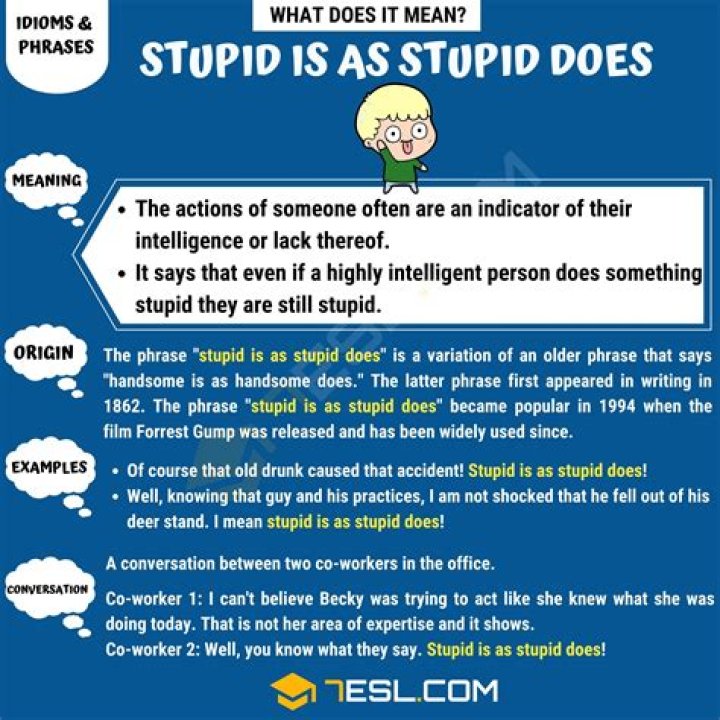
At its core, the phrase argues that stupidity should be judged by actions rather than appearance, test scores, or social perceptions. Someone might seem unintelligent by traditional measures but demonstrate wisdom through their choices and behavior. Conversely, a person with high intellectual credentials might consistently make foolish decisions.
The structure mirrors the older saying "handsome is as handsome does," which dates back to at least the 16th century. That earlier phrase suggested that true attractiveness comes from good behavior rather than physical appearance. Mrs. Gump's variation applies the same logic to intelligence.
Think of it as a behavioral definition of stupidity. You're not stupid because you struggle with calculus or can't remember historical dates. You're stupid if you repeatedly make harmful choices, ignore obvious consequences, or treat others poorly. Actions reveal character and intelligence far more accurately than any standardized test.
The quote also contains a subtle message about not pre-judging people. Someone who appears simple or unsophisticated might possess emotional intelligence, kindness, and practical wisdom that outweighs academic knowledge. Forrest himself embodies this throughout the film, succeeding in multiple fields while many "smarter" characters fail.
Cultural Impact and Modern Usage
The phrase exploded into mainstream consciousness alongside Forrest Gump's massive commercial and critical success. The film won six Academy Awards, including Best Picture, and became a cultural phenomenon that still resonates today.
People now use "stupid is as stupid does" in various contexts:
- Commenting on political decisions where highly educated leaders make questionable choices
- Discussing business failures by supposedly brilliant executives
- Defending individuals underestimated due to learning differences or non-traditional education
- Critiquing impulsive or reckless behavior regardless of the person's background
- Reminding others that credentials don't guarantee wisdom
Social media has given the quote new life. Twitter users deploy it to critique everything from celebrity scandals to corporate missteps. The phrase works perfectly in the short-form format of online discourse, packing significant meaning into six simple words.
Philosophical Underpinnings
The quote aligns with several established philosophical concepts. Pragmatism, a distinctly American philosophical tradition, emphasizes practical consequences over abstract theories. William James and John Dewey would likely approve of judging intelligence by results rather than potential or credentials.
Virtue ethics, dating back to Aristotle, similarly focuses on character demonstrated through action. Aristotle argued that virtues are habits developed through practice, not innate qualities or theoretical knowledge. Mrs. Gump's wisdom echoes this ancient insight.
Modern psychology supports the distinction between different types of intelligence. Howard Gardner's theory of multiple intelligences identifies eight separate categories, including interpersonal, intrapersonal, and practical intelligence. Traditional IQ tests measure only a narrow slice of human capability.
Emotional intelligence research by Daniel Goleman and others has shown that self-awareness, empathy, and social skills often predict life success better than cognitive ability alone. Forrest demonstrates high emotional intelligence throughout the film, despite his low IQ score.
Real-World Applications
The principle behind "stupid is as stupid does" has practical implications for education, hiring, and social policy. Schools increasingly recognize that standardized test scores don't capture the full picture of student potential. Many universities have moved toward test-optional admissions.
In the workplace, companies are discovering that cultural fit, work ethic, and interpersonal skills matter as much as technical qualifications. The most decorated resume doesn't guarantee someone will make good decisions under pressure or work effectively with a team.
The quote reminds us to look at track records. What has someone actually accomplished? How do they treat others? Do they learn from mistakes? These questions reveal far more than credentials or first impressions.
Parents raising children with learning disabilities or developmental differences often find comfort in this message. Their kids might struggle in traditional academic settings but can absolutely live successful, meaningful lives. Intelligence manifests in countless ways.
Criticisms and Limitations
Some argue the phrase oversimplifies intelligence assessment. While actions matter enormously, context also plays a crucial role. Someone might make poor choices due to lack of information, mental health struggles, or difficult circumstances rather than fundamental stupidity.
The quote could potentially justify anti-intellectualism or dismissing expertise. Just because educated people sometimes make mistakes doesn't mean education lacks value. Specialized knowledge remains essential in technical fields from medicine to engineering.
There's also a bootstrapping problem: how do we define "stupid actions" without some objective standard? Different cultures and value systems might evaluate the same behavior differently. What seems foolish in one context might be wise in another.
Frequently Asked Questions
Who originally said "stupid is as stupid does"?
The character Mrs. Gump, played by Sally Field, speaks this line in the 1994 film Forrest Gump. Screenwriter Eric Roth adapted it from Winston Groom's novel, and it has since become one of cinema's most quoted lines. While the exact phrasing originated with the film, it builds on the much older saying "handsome is as handsome does."
Can this quote apply to intelligent people making bad decisions?
Absolutely. That's precisely one of the quote's key insights. Someone with advanced degrees, high test scores, or intellectual credentials can still act foolishly. The phrase suggests we should evaluate people based on their choices and behavior rather than assumed intelligence. History provides countless examples of brilliant people making catastrophically stupid decisions.
Is there scientific support for judging intelligence by actions?
Yes. Research into emotional intelligence, practical intelligence, and multiple intelligence theory demonstrates that traditional IQ tests capture only certain cognitive abilities. Studies show that self-control, social awareness, and decision-making skills often predict life outcomes better than IQ scores alone. Neuroscience research also reveals that knowledge doesn't automatically translate into wise behavior.
The Enduring Wisdom of a Simple Quote
Three decades after Forrest Gump's release, "stupid is as stupid does" remains relevant because it addresses something fundamental about human nature. We constantly judge others based on surface characteristics while overlooking what truly matters: how people actually behave.
The quote serves as both shield and sword. It protects those underestimated by society while holding everyone accountable for their choices. No amount of education, wealth, or status excuses consistently foolish behavior. Conversely, apparent limitations don't prevent someone from living wisely.
In an era obsessed with credentials, test scores, and academic pedigree, Mrs. Gump's simple wisdom cuts through the noise. Watch what people do. That's the real measure. Everything else is just talk.