What Does IDK Mean? The Internet Slang Everyone's Using
 Sarah Cherry
If you've spent any time texting, scrolling through social media, or reading online comments, you've probably encountered "IDK" more times than you can count. This three-letter combination has become one of the most recognizable pieces of internet slang, popping up in conversations between teenagers, professionals, and everyone in between. But what exactly does it mean, and why has it become such a staple of digital communication?
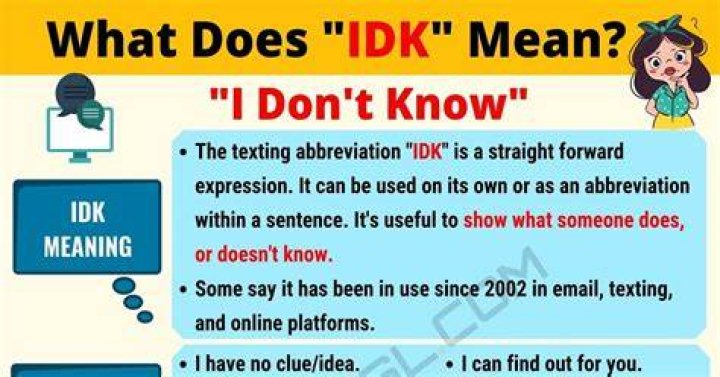
"IDK" is simply an acronym for "I don't know." That's it. Three words condensed into three letters, designed to save time and keystrokes while conveying uncertainty, lack of information, or honest admission of not having an answer. What started as a time-saving shortcut in early internet chat rooms has evolved into a linguistic phenomenon that transcends age, geography, and digital platforms.
The Origins and Evolution of IDK
Internet acronyms didn't appear overnight. They emerged from necessity during the early days of online communication when typing was slower, character limits were strict, and efficiency mattered. The 1990s saw the birth of instant messaging platforms like AOL Instant Messenger and IRC chat rooms, where users developed shorthand to keep conversations flowing.
IDK belongs to the first generation of text speak, alongside classics like LOL (laughing out loud), BRB (be right back), and TTYL (talk to you later). These abbreviations weren't just convenient—they became cultural markers of being "online" and part of the digital community. By the early 2000s, text messaging on mobile phones accelerated the adoption of these acronyms, as people dealt with tiny keyboards and character-based pricing plans.
What makes IDK particularly interesting is its staying power. While some internet slang fades quickly or becomes cringeworthy, IDK has maintained relevance across multiple technological shifts. It survived the transition from flip phones to smartphones, adapted to Twitter's character limits, and found new life in professional messaging apps like Slack and Microsoft Teams.
How People Actually Use IDK Today
The beauty of IDK lies in its versatility. On the surface, it's a straightforward expression of not knowing something. Someone asks "What time does the movie start?" and you respond "IDK, check the website." Simple, efficient, clear.
But language is rarely that simple. IDK has developed nuanced meanings depending on context, tone, and the relationship between speakers. Sometimes it's genuinely informative—you're admitting you lack specific knowledge. Other times it's dismissive, shutting down a conversation you don't want to have. It can express indifference ("IDK, whatever you want"), confusion ("IDK what's happening anymore"), or even passive-aggressive avoidance.
The acronym also functions differently across platforms. On Twitter, IDK might precede an opinion shared with deliberate uncertainty. On professional messaging apps, some workers use it to admit knowledge gaps without feeling defensive. In text messages between friends, it's often paired with other acronyms and emojis to create layered meaning.
Common Variations and Related Expressions
Like any successful piece of internet language, IDK has spawned variations and extensions that add specificity or emphasis:
- IDEK – "I don't even know," expressing stronger confusion or disbelief
- IDC – "I don't care," often confused with IDK but expressing indifference rather than ignorance
- IDGAF – A more aggressive version expressing complete disinterest (profane)
- Dunno – A phonetic spelling of "don't know" that predates internet acronyms
- ¯\_(ツ)_/¯ – The shrugging emoticon often used alongside or instead of IDK
These variations demonstrate how digital communication constantly creates new tools for expression. Users don't just adopt language passively—they modify, extend, and remix it to suit their needs.
The Psychology Behind Using IDK
Why do people choose to type three letters instead of spelling out "I don't know"? The reasons go deeper than mere convenience. Research into computer-mediated communication suggests that abbreviations create a sense of informality and intimacy. They signal that you're part of an in-group that understands digital conventions.
Using IDK can also soften the psychological impact of admitting ignorance. "I don't know" spelled out might feel more formal, more final. The abbreviated version feels lighter, more casual, less like a confession of inadequacy. This matters in cultures where admitting uncertainty can feel uncomfortable or face-threatening.
There's also an efficiency factor that remains relevant despite modern smartphones and predictive text. While typing has become easier, attention spans have shortened. People scan messages quickly, and brevity helps important information stand out. Three letters register faster than thirteen (including spaces).
Professional Settings and IDK Etiquette
The appropriateness of using IDK depends heavily on context. Among friends and peers, it's completely acceptable and even expected. But what about professional environments?
Workplace communication has grown increasingly informal, especially in tech companies and remote work settings. Many professionals now use IDK in internal messaging apps without thinking twice. However, external communication with clients, formal emails, and presentations still call for more traditional language.
Some communication experts suggest that over-reliance on IDK in professional settings can undermine your credibility. Instead of simply saying "IDK," they recommend phrases like "Let me find that information for you" or "I'll need to research that before providing an accurate answer." The difference isn't just about formality—it's about demonstrating initiative and professionalism.
That said, there's value in honest uncertainty. A well-timed admission of not knowing something can build trust and show intellectual humility. The key is following up with action rather than leaving IDK as the final word.
Generational Differences in Usage
IDK crosses generational lines more successfully than much internet slang, but usage patterns differ. Younger users who grew up with smartphones often use IDK interchangeably with the full phrase, switching based on mood rather than formality. They might spell it out when being serious and abbreviate when being casual.
Older generations who adopted digital communication later sometimes view acronyms as juvenile or lazy. They might understand IDK but choose not to use it themselves, seeing it as emblematic of declining language standards. This tension reflects broader anxieties about how technology changes communication.
Interestingly, middle-ground users—those who came of age during the early internet—often have the most flexible relationship with IDK. They remember when using it felt edgy and new, but they've also watched it become mainstream enough for their parents to use.
IDK in Global Communication
English-language internet acronyms have spread globally, often used even by non-native English speakers. IDK appears in multilingual group chats, international business communications, and social media posts written primarily in other languages. This reflects English's role as the lingua franca of the internet, but also the universal need for efficient digital communication.
Some languages have developed their own equivalents. Spanish speakers might use "NSN" (no sé nada), though IDK remains widely understood. French internet users recognize "JSP" (je sais pas). However, English acronyms often dominate due to the American origins of many social media platforms and the global reach of English-language internet culture.
Frequently Asked Questions
Is it okay to use IDK in formal writing?
Generally, no. Academic papers, business proposals, formal reports, and professional correspondence should use complete sentences and avoid internet acronyms. Save IDK for casual digital communication with appropriate audiences. When uncertain in formal contexts, use phrases like "This information is currently unavailable" or "Further research is needed to answer this question."
What's the difference between IDK and IDC?
IDK means "I don't know"—you lack information or are uncertain about something. IDC means "I don't care"—you have no interest or preference regarding something. While they look similar, they express completely different sentiments. Confusing them can lead to miscommunication, especially since IDC can come across as dismissive or rude in contexts where someone expects engagement.
Can using too much text speak like IDK hurt your communication skills?
Research on this question is mixed. Some studies suggest that frequent abbreviation use correlates with weaker formal writing skills, particularly in younger students. However, other research indicates that skilled communicators code-switch effectively, adjusting their language to match the situation. The key is maintaining awareness of context and audience. Using IDK with friends doesn't damage your ability to write properly in professional settings—unless you lose track of when each style is appropriate.
Final Thoughts
IDK represents more than just an abbreviation. It's a small window into how digital communication shapes language, relationships, and self-expression. Three letters carry decades of internet history, generational attitudes toward technology, and the constant human need to communicate efficiently while maintaining connection.
Whether you love it, hate it, or feel somewhere in between, IDK isn't disappearing anytime soon. It has earned its place in the digital lexicon through utility, adaptability, and widespread recognition. The next time you see those three letters, you'll know there's more behind them than meets the eye. Or maybe not. IDK.