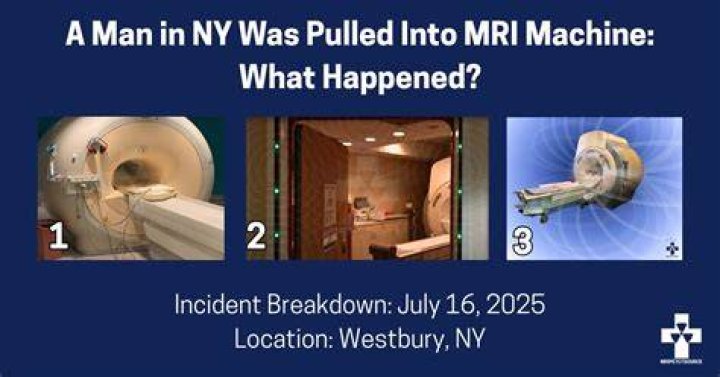
Man Sucked Into MRI Machine: What Happened and Why It Matters
 Olivia Owen
 In August 2018, a tragedy unfolded at a hospital in Mumbai, India, when a man was literally pulled into an MRI machine by its powerful magnetic field. Rajesh Maru, a 32-year-old visitor accompanying a relative for a scan, died after being dragged into the scanner while carrying an oxygen cylinder. The metal canister became a projectile, and the magnetic forces were so intense that Maru was trapped inside the machine's bore. He suffered severe injuries and later died from inhaling liquid oxygen that leaked from the ruptured cylinder.
This incident shocked the medical community worldwide and served as a grim reminder of just how dangerous MRI machines can be when safety protocols fail. The magnetic field generated by these devices is always on—even when no scan is taking place—and it's powerful enough to turn everyday metal objects into deadly weapons. What happened in Mumbai wasn't an isolated freak accident. It was the result of negligence, inadequate training, and a catastrophic breakdown in hospital safety procedures.
Understanding MRI Magnetic Fields
Magnetic Resonance Imaging machines use superconducting magnets that generate fields thousands of times stronger than Earth's natural magnetism. A typical MRI operates at 1.5 to 3 Tesla, though some research machines reach 7 Tesla or higher. To put that in perspective, a refrigerator magnet measures about 0.001 Tesla.
These magnets are always active. There's no off switch. Even during power outages or between scans, the magnetic field remains at full strength. This constant force creates what medical professionals call the "fringe field"—an invisible zone extending several meters from the machine where ferromagnetic objects experience pull.
The closer you get, the stronger the attraction becomes. Small items like pens, scissors, or jewelry can fly from your hands. Larger objects—oxygen tanks, IV poles, wheelchairs, gurneys—become uncontrollable. People have been pinned against machines by flying equipment. Technicians have suffered broken bones trying to retrieve metal objects. The force is not gradual. It's sudden, violent, and overwhelming.
What Happened in the Mumbai Case
Rajesh Maru entered the MRI room carrying a portable oxygen cylinder for a patient. Hospital staff had allegedly told him it was safe to bring the tank inside. It wasn't. The cylinder was ferromagnetic—made of materials that respond powerfully to magnetic fields.
Within seconds of entering the room, the oxygen tank was ripped from Maru's hands. He tried to hold on. The magnetic pull was estimated at several hundred pounds of force. Both Maru and the cylinder were dragged toward the machine's opening. He became wedged between the tank and the scanner bore.
Bystanders couldn't pull him free. The magnetic field held everything in place with relentless force. By the time hospital staff managed to deactivate the magnet—a process called "quenching" that requires venting thousands of liters of liquid helium and can take several minutes—Maru had inhaled liquid oxygen escaping from the damaged cylinder. He suffered severe frost burns to his lungs and died shortly after.
Investigations revealed multiple safety failures. The oxygen cylinder was not labeled properly. Staff hadn't verified whether it was MRI-safe. The door to the MRI suite apparently wasn't properly secured. Warning signs were inadequate. Some reports suggested that personnel operating the facility lacked proper certification.
Previous MRI Accidents and Near Misses
Mumbai wasn't the first time someone was hurt by an MRI machine's magnetic field. These incidents happen more often than most people realize, though they're frequently underreported.
- In 2001, a six-year-old boy died in New York after a metal oxygen tank flew into an MRI scanner, striking him in the head.
- Countless cases involve hospital equipment—crash carts, IV poles, patient beds—becoming stuck inside MRI bores, causing delays and sometimes injuries.
- Maintenance workers have been injured when carrying tools too close to MRI rooms, not realizing the magnetic field extends beyond the scanner itself.
- Firearms have been pulled from security officers' holsters, accidentally discharging in at least one documented case.
- Anesthesia equipment, ventilators, and monitoring devices have malfunctioned or been damaged when brought too close to MRI fields.
The American College of Radiology tracks these events through voluntary reporting, but experts believe many incidents go unreported. Facilities worry about liability. Staff fear disciplinary action. Patients often don't realize what happened or why.
Why MRI Safety Protocols Exist
Hospitals and imaging centers follow strict zoning protocols to prevent accidents. The American College of Radiology divides MRI facilities into four zones:
Zone I is freely accessible to the public—waiting rooms and hallways outside the MRI suite.
Zone II serves as an interface between public areas and restricted zones. Patients get screened here before proceeding further.
Zone III is restricted to screened patients and trained personnel. No ferromagnetic objects are allowed beyond this point without explicit authorization.
Zone IV contains the MRI scanner itself. Only MRI-safe equipment and thoroughly screened individuals can enter.
Every person—patients, visitors, medical staff, maintenance workers, even physicians—must complete detailed screening questionnaires before entering Zone III or IV. These forms ask about implanted medical devices, previous surgeries, occupational metal exposure, and any metallic objects on their person.
MRI technologists receive specialized training in magnetic safety. They learn to identify ferromagnetic objects, understand field strength zones, and implement emergency protocols. Many facilities employ metal detectors at Zone III entrances as a final safety check.
Common Misconceptions About MRI Safety
One dangerous myth is that MRI machines can be "turned off" quickly in an emergency. They can't. The only way to eliminate the magnetic field is through quenching—deliberately venting the liquid helium that keeps the superconducting magnet at near absolute zero temperatures. This process is expensive (often costing $50,000 or more), potentially damages the machine permanently, and still takes precious minutes to complete.
Another misconception is that only large metal objects pose danger. Small items like hairpins, paper clips, or underwire bras can heat up during scans, causing burns. Metallic tattoo inks containing iron oxide can cause skin irritation. Even non-ferromagnetic metals like aluminum can interfere with image quality or create heating risks.
Some people assume that if they've had previous MRIs without problems, they're safe for future scans. But circumstances change. You might have had recent dental work, a newly implanted device, or picked up a metal splinter at work. Every scan requires fresh screening.
Legal and Regulatory Consequences
After Rajesh Maru's death, Mumbai police filed charges against the MRI machine operator and a doctor for causing death by negligence. The hospital faced intense scrutiny over its safety protocols and staff training.
The incident prompted calls for stricter regulation of medical imaging facilities throughout India. Safety advocates pushed for mandatory certification programs, regular audits, and clearer accountability when protocols fail.
In the United States, MRI safety falls under multiple regulatory bodies. The FDA oversees device approval and labeling. The Joint Commission establishes hospital accreditation standards. State health departments conduct inspections. Professional organizations like the American College of Radiology publish detailed safety guidelines, though compliance is sometimes voluntary.
When accidents occur, hospitals face lawsuits, regulatory fines, and potential loss of accreditation. Staff members can face criminal negligence charges if their actions directly caused injury or death. Insurance premiums increase. Reputations suffer lasting damage.
Technology and Training Improvements
Modern MRI facilities have implemented enhanced safety measures since high-profile accidents. Many now use ferromagnetic detection systems—sophisticated metal detectors that prevent anyone carrying magnetic materials from entering scanner rooms. These systems can detect metal objects through clothing and sound alarms before accidents occur.
Color-coded equipment helps staff quickly identify MRI-safe versus MRI-unsafe items. Green labels indicate equipment that's safe in all zones. Yellow items require conditional approval. Red-labeled equipment must never enter Zone III or IV under any circumstances.
Virtual reality training programs now simulate emergency scenarios, helping staff practice responses without real-world risk. These programs recreate the panic and confusion of actual incidents, training teams to follow protocols under pressure.
Some facilities have adopted "angel" systems—handheld devices that screen patients and staff for ferromagnetic objects before they approach the MRI room. These catch items that questionnaires and visual inspections might miss.
Frequently Asked Questions
Can an MRI machine actually suck a person in?
Yes, but it's not the person being pulled—it's ferromagnetic objects they're carrying or wearing. The magnetic field exerts tremendous force on iron, nickel, cobalt, and certain steel alloys. If someone holds a metal object near an MRI, the magnet can pull both the object and the person holding it toward the machine. The pull intensifies exponentially as you get closer, making it nearly impossible to resist.
How strong is the magnetic field of an MRI?
Clinical MRI machines typically operate between 1.5 and 3 Tesla. Earth's magnetic field measures about 0.00005 Tesla by comparison. That means an MRI is 30,000 to 60,000 times stronger than the planet's natural magnetism. This field can accelerate a metal oxygen tank to dangerous speeds in a fraction of a second, and it extends several feet beyond the machine itself.
What should I do if metal gets stuck in an MRI machine?
Never try to pull metal objects out yourself. The magnetic force is far stronger than human strength, and attempting removal can cause serious injury. Immediately notify MRI staff, evacuate the room, and let trained technicians assess the situation. In extreme emergencies where someone is trapped and injured, staff may initiate a quench to deactivate the magnet, but this decision requires careful consideration due to the cost, potential equipment damage, and time involved.
Are all medical implants dangerous in MRI machines?
Not necessarily. Many modern implants are MRI-conditional, meaning they're safe under specific circumstances—certain field strengths, particular scanner configurations, or limited scan durations. Others are MRI-safe, meaning they contain no metal or only non-ferromagnetic materials. However, older implants, especially those placed before the 1990s, may not be compatible with MRI. Always inform your technologist about any implanted devices, and bring documentation from your surgeon if possible.
Final Thoughts
Rajesh Maru's death was preventable. It resulted from human error, inadequate training, and organizational failures—not from any inherent flaw in MRI technology. These machines save countless lives by enabling doctors to diagnose strokes, tumors, infections, and injuries without invasive procedures. But they demand respect and rigorous safety protocols.
The magnetic field that makes MRI so valuable for medicine is the same force that makes these machines potentially lethal when mishandled. There's no room for shortcuts, assumptions, or complacency. Every person entering an MRI suite must be properly screened. Every piece of equipment must be verified as safe. Every staff member must understand the physics and risks involved.
Medical imaging centers worldwide have learned from tragedies like Mumbai. Safety systems have improved. Training has become more comprehensive. But vigilance can never be taken for granted. The next accident is always just one overlooked detail away.
